
Jul 22, 2026 · 6 min read
The Upper Triangle of Tension: What Your Jaw, Neck & Shoulders Are Protecting You From
Inside a recent live session on the body's most common holding pattern: why it forms, what it is guarding, and the small movements that convince the nervous system to finally put it down.
There's an image I offered at the start of this session that I keep coming back to: tension is like an umbrella on a rainy day. You want to have one. It's useful. It protects you. But you don't want to hold it open all the time, because then it blocks the sun, your arm gets tired, and it stops serving you at all.
That's the story of the jaw, the neck, and the shoulders for most of us. Not a malfunction. Not a personal failing. A protection that was genuinely useful once, and then never got put down.
So before anything else, I asked everyone in the session to make a bracket, at least for our hour together, around the idea that something is wrong with them or broken and needs fixing. Because if you've seen it that way, and the things you've tried haven't worked, sometimes it's a different way of looking that begins the shift.
One triangle, three protections
I framed the whole region as an inverted triangle: from the edges of the shoulders up through the neck to the head, taking in the jaw and the throat. The body holds this triangle for protection. And each corner protects something different.
The jaw holds back words. Think of every time you had something to say and didn't, because it felt inappropriate, or unsafe, or you feared what would come back at you. You closed your mouth, pulled the tongue in, and held. Over time, that holding became clenching, and the clenching became invisible. The jaw is connected to the throat even more than to the neck. It is what keeps our words in. Sometimes there's a little anger stored there too, because holding back was never really what you wanted. It's what you had to do to stay safe.
The neck holds the conflict between head and heart. The neck is the bridge between them: thoughts above, feelings below. Any time the two went into a tug of war (I feel this, but I don't think it's safe to act on it), the neck braced and held it together. You can see it there: the resistance, the holding back, the unresolved vote between what you feel and what you think.
The shoulders hold responsiveness. Every time the world asks something of you, an email, a person, a work situation, a health worry, a financial one, you brace, just a little. And then a little more. Like a thermostat rising so slowly you never notice, until braced becomes your neutral. Not resting tone. Tight tone, as your new normal. That's why massage helps for a day and then the tension returns: the brain brings it back, because the brain still believes it's needed.
The reframe of the whole evening was this: nothing here is bad. No "bad neck, bad jaw, why did you do that?" It served a purpose. It protected you. It's simply not needed anymore, and we can offer the body a new option.
Why we don't fight it, we visit it
Here's the part that surprises people. In the practice, we didn't stretch away from the tension. We went toward it, on purpose.
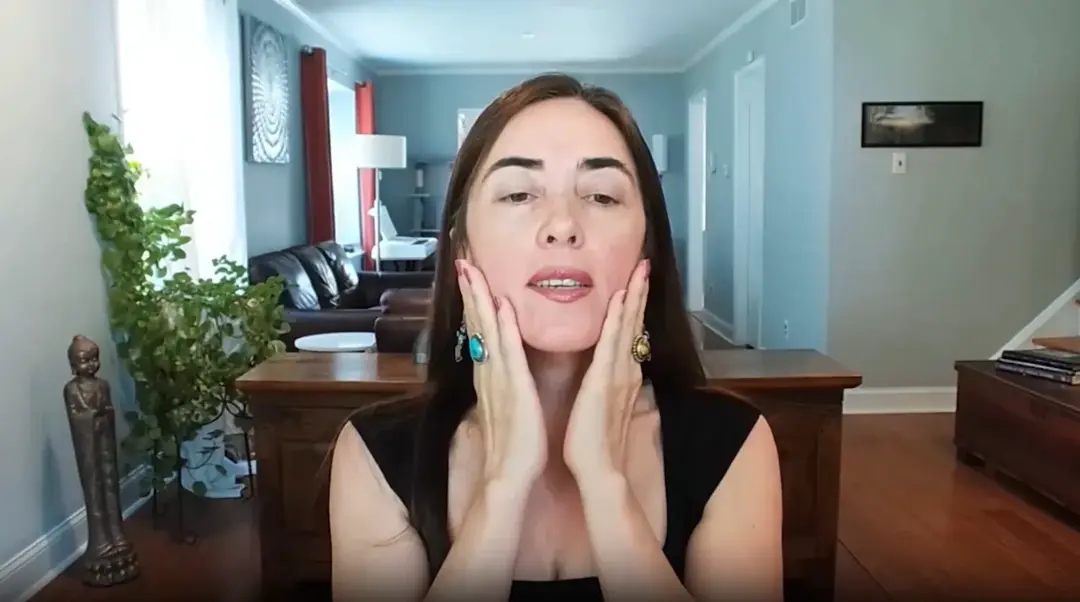
With our own hands holding the jaw the way you'd hold an instrument's bow, we recreated the clench: lifting, tightening, shoulders rising, breath held, everything pulled up. And in that held place, I asked everyone to notice something honest. There is a miniature sense of safety in there. Tight, contained, invisible, making no waves. The brain recognizes that. But it is so inefficient. It is costing you so much.
"You're working so hard for this. So begin to slowly undo, unclench, release, drop down, melt down, as if you can put a bag down on the floor. You've been carrying a huge, heavy backpack. For now, I'm just going to drop that down."
Dayana
Then we did something even stranger. Inside the clench, we looked for a little freedom: tiny circles, a little side to side, ease inside the constraint. And then the same movement again in the released position, looking not for range but for smoothness. Like silk, like water, like honey. The brain feels the difference between the two, really feels the cost of the bracing, and over time it draws its own conclusion: why would I waste energy holding this? You don't have to force the release. The body stops on its own.
This is Feldenkrais® at its heart. Not pushing the body into better positions, but giving the nervous system a clear comparison and trusting its intelligence to choose the easier way.
The one habit that changed everything for me
I shared something personal in this session: my own default jaw position. Most people rest with their teeth in contact, clenched or nearly so. I rest with a little space. If you X-rayed me at any hour, you'd find it there.
It didn't start that way. I used to brace like everyone else, and it interfered with everything: singing, teaching, speaking. What changed it was awareness, checked in on constantly. Where's my jaw? Where's my jaw? And then the unlock, letting the lower jaw hang like a hammock. You can do it with your mouth closed. No one can tell. It is the slightest un-click, un-clench, and carrying that through the day became the biggest upleveling of my life in this work.
If you've carried a tight jaw for many years, this might be hard at first, so you don't have to begin there. Begin with the practice. The space comes.
Becoming a detective of yourself
The final movement of the session left the mat entirely. Feldenkrais called it becoming a Sherlock Holmes of yourself: pick one daily action, opening a door, reaching for a mug, sitting down, and observe how you do it, watching the jaw, the neck, the shoulders, changing nothing. Then do it again with the bracing turned up on purpose, and recognize yourself. Ah, this is me under stress. Then turn the page. Clean slate. Unlock the jaw, drop the shoulders (which lengthens the neck by itself) and do it the new way, with a little extra movement added.
Notice. Drop. Add movement. That sequence works on anything: driving, cleaning, sitting at the computer. It is never about what you're doing. It's about how.
What the room felt
"I feel incredibly relaxed."
Martha
"My neck was saying more, more, more."
Patty
"I noticed a relationship between the hip and the jaw."
Linda
That last one delighted me, because it's exactly right. The pelvis is a triangle too, inverted against the upper one, and the two are connected through the spine. Chances are, if you're holding your jaw, you're also holding your pelvic floor. They soften together. But that's a whole session of its own.
Members: watch the full session inside ONE
If you're a member of ONE, this complete live session, the teaching, the full guided practice, and the Q&A, is waiting for you in your Bonus Content, included with your membership. Lie down, follow along, and let your nervous system have the whole hour.
Watch the full session in Bonus Content
And remember what I asked at the end: please practice. Take one thing, the unlock, the backpack, the detective, and repeat it until the new bridge is stronger than the old one. That's how the brain keeps what it learns.
Turn knowledge into body wisdom
Not a member yet? ONE: Your Roadmap to Embodiment is my living somatic membership. Five pathways, live somatic sessions twice a month, a growing library of practices, and bonus sessions like this one, all included.
Turn knowledge into body wisdom.
Reading is one thing. Letting it land in the body is another. Begin a session, take the pathway quiz, or step into the membership.