

Freedom Is Learned
a live somatic immersion with dayana pereira · starts october 6
Your jaw, your shoulders, your sleep, your gut.
They may not be four separate problems.
More ease in your body. More choice when it matters.
Build a system with more than one option, so the relief you find in practice begins to travel into the rest of your life.
Ten live Tuesdays on Zoom, one individual session, simple daily practice, and a small group of twenty-four.
October 6 – December 15.
Founding rate for the first twelve seats.
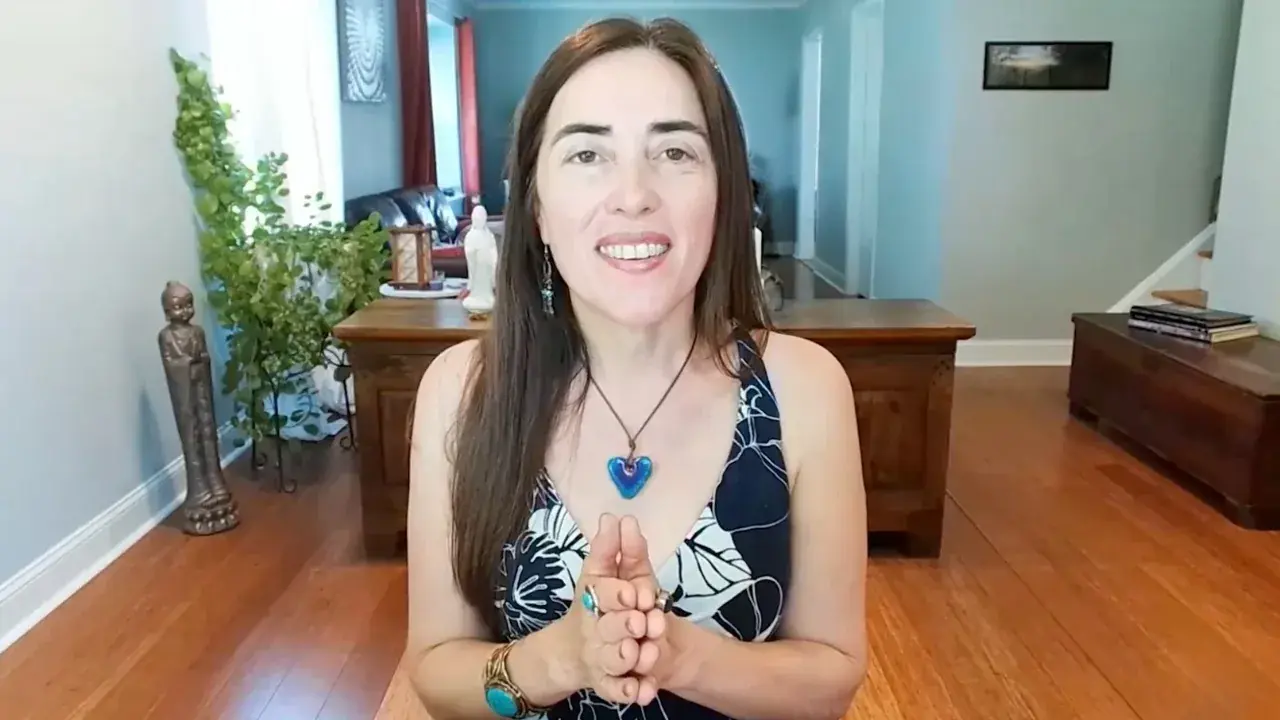
a few minutes from dayana
you may already know my voice
The videos help. They were never going to be enough.
If you found me through Insight Timer, you've probably practiced one of these: releasing jaw, neck and shoulder tension. Why tension builds. What trauma does to the body. A five-minute nervous system reset.
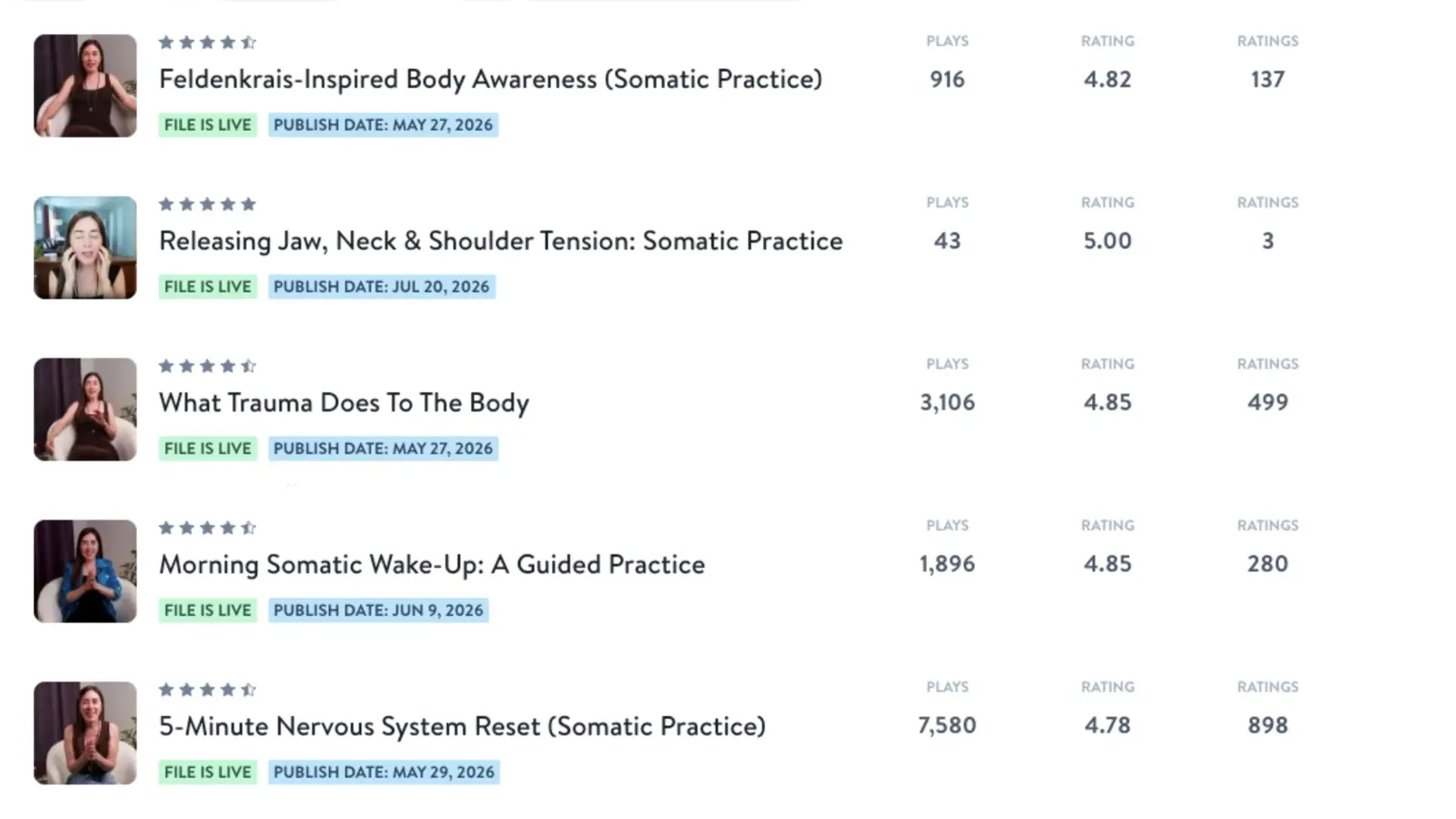
They work. Thousands of people say so, and I'm glad.
But I want to be honest about what a fifteen-minute recording can and can't do. It can change your afternoon. What it can't do is accumulate, because there's no sequence, nothing builds on the thing before it, and nobody is watching you move.

So people write to me. They ask about working one to one, and then they see what that costs, and most of them can't do it.
This program is my answer to those emails. Not a discounted version of private work, and not a collection of classes. It's a different kind of container: ten live sessions in a deliberate sequence, simple daily practice so each week's learning has time to settle, one individual session to make the work personal, and a small group moving through the process together.
what's actually happening
You've had relief. It just didn't travel.
You've probably treated your jaw, your shoulders, your sleep and your digestion separately. Different practitioners, different explanations, different protocols. That's reasonable. They don't look related.
Symptoms can diversify. Deeper patterns of organization can repeat.
Those symptoms may not be as separate as they appear. Different symptoms can reflect deeper patterns of organization that repeat across the body, which would explain why treating them one at a time has been so much effort for so little return.
And here's what happens to the relief when it does come. It stays on the mat, in the session, inside the twenty minutes. Then Monday arrives with its ordinary demands and your system goes straight back to what it knows.
That isn't a discipline problem. Calm isn't a technique: it's what becomes available when your system has more than one option. More internal steadiness can become available even when your circumstances aren't perfect.
One thing I was trained to see differently
People often describe trauma as stored, held, or stuck in the body, and those words can describe the experience remarkably well. I use the research they come from, and I teach trauma science in this program.
The Feldenkrais® Method offers another way to understand what may be happening.
Under threat or prolonged stress, the nervous system can begin relying on a smaller set of responses: bracing, withdrawing, controlling, pleasing, pushing through. Those responses may have been intelligent adaptations to what was happening then.
The problem comes when they remain the only responses that feel available now.
Which is why stuck often describes it so well from the inside. It's what having one option feels like.
So the work isn't only to discharge what's held. It's to give your system somewhere else to go.
Range isn't released. It's learned.
So is freedom.
One distinction, because without it this is false: more options is not always better. A pianist has fewer options in a moment than a beginner, and that's competence, not damage. What we're restoring is choice where an old protective pattern has become automatic.
what this usually looks like
A composite. Not one person.
Drawn from fifteen years of clients, combined and changed.
Julia is forty-seven. Two kids, a job where people use the word indispensable about her, a mother who calls most days.
Her shoulders have been up around her ears for years. Her jaw wakes her at three in the morning. She has a chiropractor, a night guard, and a folder of vagus nerve exercises she's started four times. She meditates, though lately meditation makes her chest tight, which she takes as evidence she's doing it wrong.
What she says in the first session is: "I know all of this. I just can't seem to do it."
Nothing dramatic happens. In the third session, doing something small with her ribs, she notices her jaw let go. Nobody touched it. Her ribs moved, and her jaw turned out to be attached to something that had also been holding.
That's the whole event. Not a breakthrough: a piece of information. Her jaw wasn't the whole problem. It was where the larger pattern had become visible.
Six months on, her shoulders still come up. What's different is that she notices at eleven in the morning instead of at midnight, and she knows three things that bring them down, and she found all three herself.
what becomes possible
Not what you'll have. What you'll be able to do.
- I can feel my shoulders drop, and I know what I did to let them.
- I notice my jaw before it's been clenched for an hour.
- I can feel what I'm doing before I try to change it.
- I can tell a sensation from the story I’m telling about it.
- I know what settles my system, because I found it myself and not off somebody's list.
- I can tell the difference between a guard I still need and one I don't.
- I can stay with something uncomfortable without overriding it or collapsing under it.
- I can receive something good without bracing for the drop.
- I have more than one response available when it matters, not only when it's quiet.
- I can tell my yes from my no.
- I know my own way back, and I don't need anyone to hand it to me.
four pillars
Lasting change involves the whole of you.
Most programs pick one of these and call it the whole thing. The reason your insight hasn't reached your body, or your body work hasn't reached your life, is usually that the other three were missing.
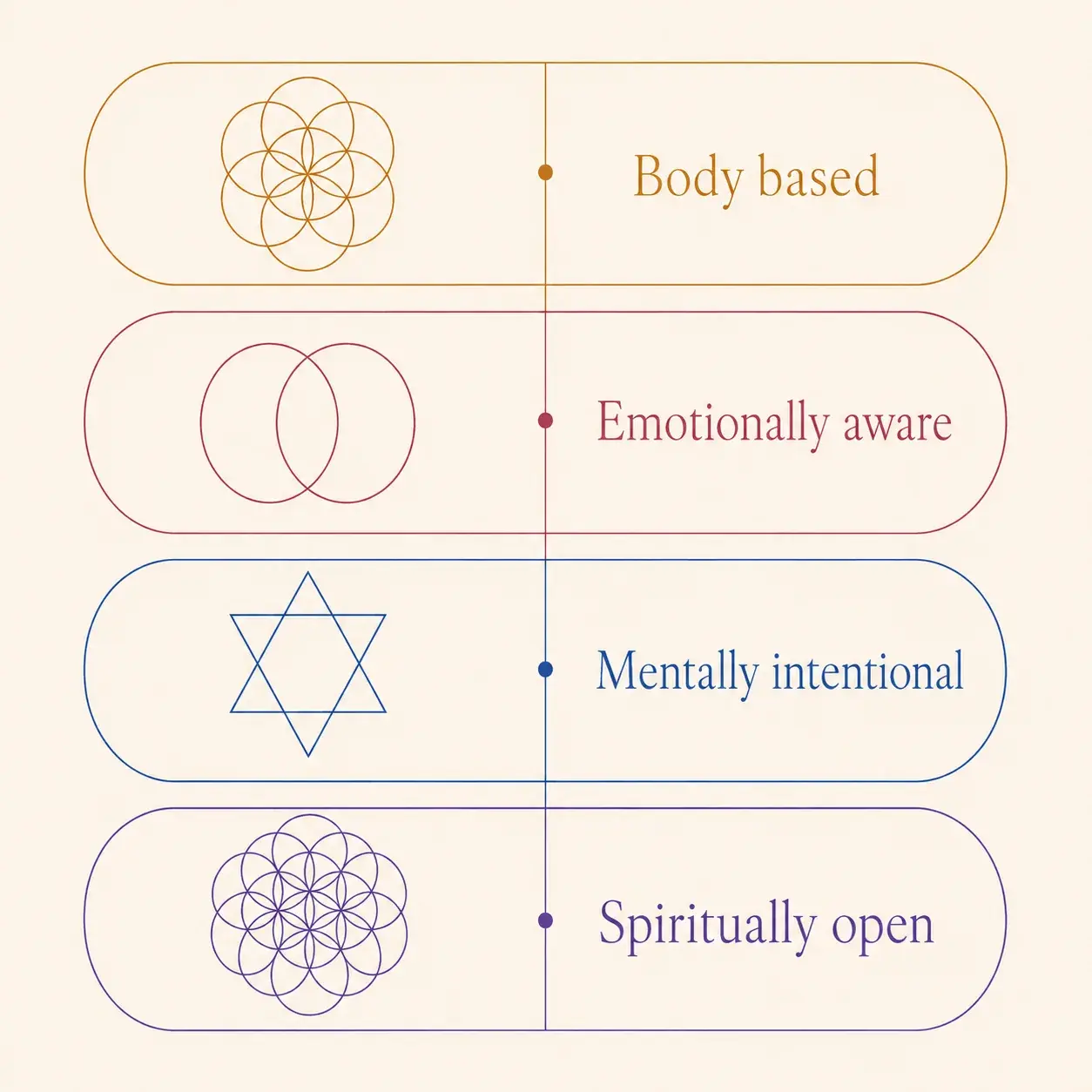
Body based
Where the trauma response takes hold in you, specifically, and what regulates your system, found by testing, not handed to you off a list. And how to build the bandwidth to hold more without tipping over.
Emotionally aware
Feeling thoroughly. All of it, not the acceptable half. Contraction and resistance, and also expansion and freedom, until body and heart support one another.
Mentally intentional
Becoming aware of the thoughts and beliefs you're running, and working with them through inquiry rather than argument. Letting the mind inhabit the body rather than run the show.
Spiritually open
Telling intuition from anxiety, verifiably, in the body. Feeling supported by life force rather than reliant on your own effort, and extending compassion to yourself first.
Nothing here requires belief, and nothing here asks you to set your spiritual practice aside.
why it's built this way
Change needs novelty. Learning needs return.
One good session can show you something new. Learning takes repetition.
Novelty opens
New movement gives your system something it hasn't tried before: a window in which another response can become possible.
Return consolidates
Coming back to that experience helps the new response become more available. Without return, even a powerful session can fade quickly.
The live session introduces the week’s lesson. The practice between sessions gives you repeated contact with it, so you can begin to recognize it outside the session too.
The pace is deliberate: one lesson, one week, enough time to notice what changes.
three things that make this different
Live, small, and intentional.
Feldenkrais, taught live.
Guild Certified: an 800-hour professional training across four years, plus an eighteen-month post-graduate. Not a weekend certificate. I have taught this work to thousands of people worldwide, and it is a named lineage with fifty years of pedagogy behind it.
A small group. Twenty-four people.
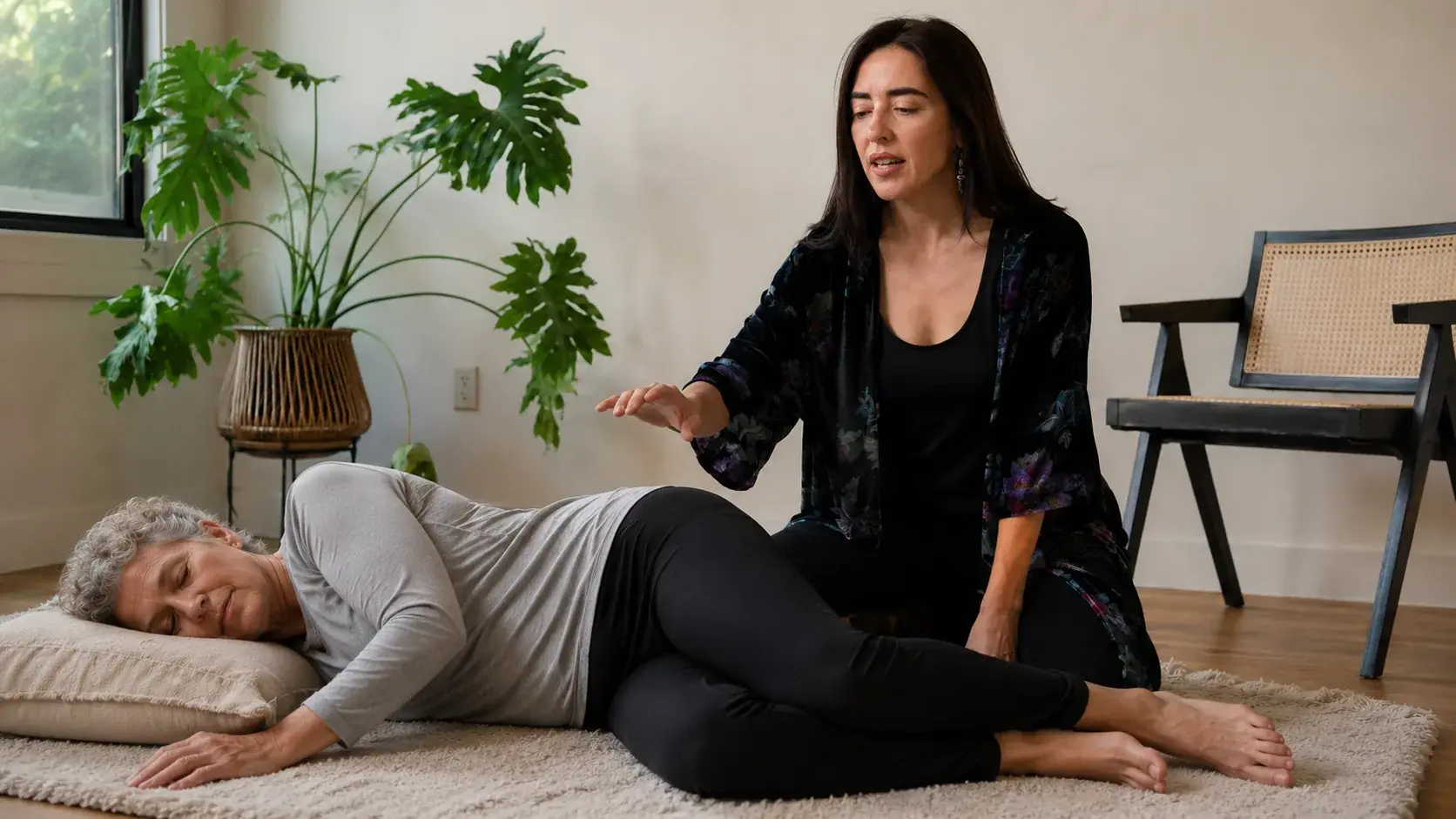
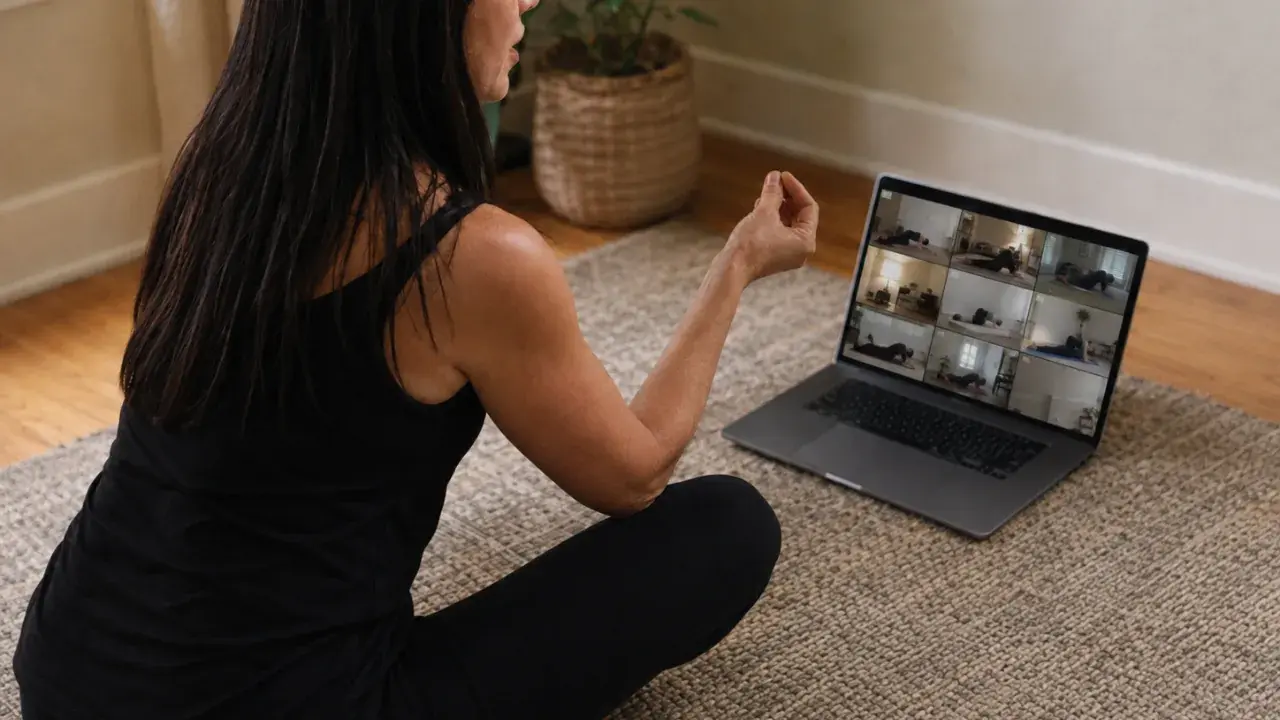
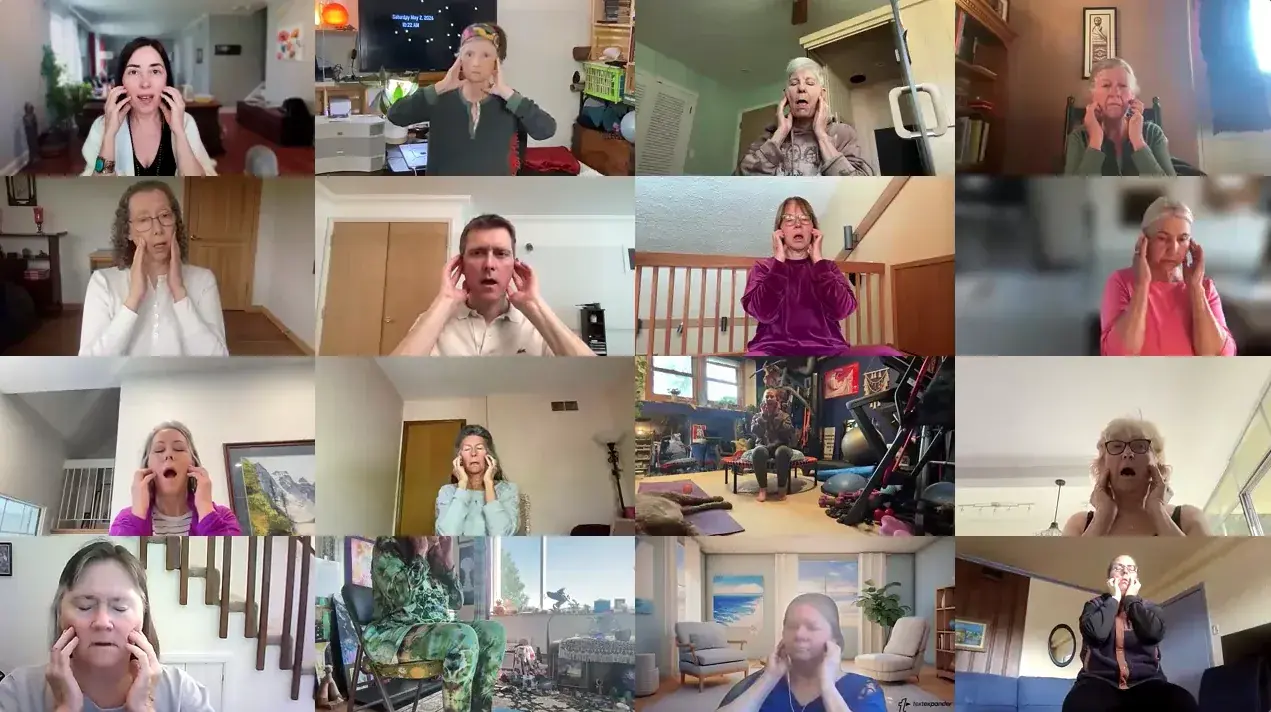
Most programs at this level scale by removing the teacher. You get videos and a support inbox. Here you get ten live sessions with me and one individual session, just the two of us. For partner work and questions we split into two groups of twelve. I'm in the room, and I can see how you move.
Movement first. Insight after.
You won't talk your way into a different nervous system. You'll move in ways your body hasn't moved, and the understanding arrives after the change, which is the order it actually happens in.
ten sessions · three phases
Notice it. Learn another way. Take it with you.

Arriving
Sessions 1–3 · October 6–20
I can perceive myself clearly enough to work with what is actually happening.
Where You Are Now: map your starting point in your own words, so you can see what changes by the final session
The Body’s Language: distinguish sensation, emotion, impulse, and the story built around them
What Actually Regulates You: discover what genuinely helps your system return, through experience rather than somebody else’s list
Deepening
Sessions 4–7 · October 27 – November 17
I can meet an old pattern without automatically becoming it.
Where It Took Hold: recognize how a protective pattern organizes you now, what it has been trying to do, and where another option can begin
Feeling Thoroughly: stay with what you feel in amounts you can actually meet, without overriding it or disappearing inside it
Expansion Without Losing Yourself: receive ease, pleasure, support and possibility without bracing, performing, or pulling away
The Mind That Inhabits: find a belief in the body, then choose the thought that supports a different way of being

Integrating
Sessions 8–10 · December 1–15
I can carry what I’ve learned into the moments where I actually need it.
Choosing Under Load: bring choice into conflict, demands, boundaries and real-time pressure, not just the quiet of the floor
Trust as a Body Signal: learn the felt differences between urgency, fear, habit and a quieter sense of knowing
Your Own Way Back: revisit where you began, name what has changed, and create your personal map for noticing, choosing and returning
Rest week over Thanksgiving, November 24. Built in on purpose. A program about not overriding your body should not override your body.
who this is built for
You're competent, capable, and running on far less than you admit.
- Tension in your jaw, neck, shoulders or low back that comes back no matter what you do
- Sleep that happens but doesn't restore you
- Digestion that reacts to more things every year
- Fatigue that rest doesn't help, and an attention span that used to be longer
- Pain that has outlasted every explanation you've been given
- You give more than you receive, and you've stopped noticing
- You've done the inner work. The insight didn't transfer to your body.
- You can regulate when it's quiet and lose it entirely when it isn't

And one more, which most programs won't name:
Your spiritual practice keeps opening things your body can't hold yet. Meditation surfaces panic. Breathwork surfaces rage. Energy work leaves you wired for days. You've wondered whether you're doing it wrong.
You're not necessarily doing anything wrong. Practices that ask for stillness can surface what's easier to avoid while you're busy. Learning how much your system can meet at once, and building capacity without overriding yourself, is part of what this program trains.
I'm a Reiki Master and I run a monthly embodiment circle. This work won't ask you to set your spiritual practice aside.
who this isn't for
Three reasons to skip this one.
- You're in acute crisis and need clinical care. This is somatic education, not therapy, and I'll say so plainly rather than take your money.
- You want techniques without practice. There is daily work, and it's the part that changes things.
- You want to be fixed. I understand the wish: it would be easier if someone could do this to you. But nothing here works that way. I don't fix people, because people aren't broken. We learn, together, and what you build is yours to keep.
in their words
5.0 stars, 60 reviews, one practitioner.
"Grateful for Dayana — her voice, her skill, her listening, her knowledge and talent. She has a keen way of gentle-ing (my word) one through the obstacles, the questions, the confusion, the muck and all the stickiness in-between so you can see your diamonds. … Just the glimpse of and felt sense of my mind-body connection is worth far more than the price of admission."
Dorry Bless"I have been working with Dayana for close to 8 years, both receiving Feldenkrais treatments and attending classes in person and online. She has helped me tremendously, with chronic pain issues, alignment, attitude. She is a very gifted healer, a wise and very loving person. I recommend her very highly."
Jane McRory"Incredibly kind and helpful. I've done years of physical therapy without much progress, and her methods gave me the tools to heal on my own in only a few visits. Now I can exercise without fear of injury!"
Jennie Cook-Kollarson the recordings
The recordings already work. Thousands of people say so.
The daily practice here is a recorded lesson, so it's fair to ask whether that part works when I'm not in the room.
It does. My somatic practices have been played more than 150,000 times on Insight Timer, by a following of 6,500, and rated 4.77 across 9,645 ratings: sessions on jaw, neck and shoulder tension, on why tension builds, on what trauma does to the body. This program is those recordings put in the right order, with the teaching that makes them cumulative, and me in the room while you do them.
"It really suits my easily activated nervous system."
Leigh, Australia"SO helpful! Suffering months after dental work and this was a great start to restoring natural jaw mobility. Many repetitions of the class in my future."
Rita Mirador"Excellent for relieving tension in the lower back."
Esteban Bruno · translated from Spanish
the structure
Ten live Tuesdays, with simple practice in between.
Twenty-four seats, in two groups of twelve.
What I'll ask of you
You'll sign a short agreement at enrollment. Not paperwork for its own sake: the cohort moves together, and it only works if we all actually show up.
- Attend live, or watch it that same week. Not the week after. Before the next session.
- Stay for the whole session. Sixty minutes. The integration at the end is where the change gets consolidated.
- Communicate with the community. You don't have to share deeply. You do have to not disappear.
two rates
The first twelve seats are the founding rate.
The founding rate is for the first twelve people who say yes. They're trusting me with something that hasn't run before, and this is how I thank them. When those twelve seats are taken, the rate moves to $1,111.
Founding · First 12 seats
or 2 payments of $477 · $954 total
Take this seat →
General rate
or 3 payments of $397 · $1,191 total
Take this seat →
Either rate is open to you now. If two payments of $477 is more than this month allows, the general rate splits into three smaller ones.

What's included
| One individual session with me | $180 |
| Ten live group sessions | $750 |
| One year inside ONE | $299 |
| Three workbooks | included |
| Private community + practice partner | included |
| Total value | $1,229 |
| Founding rate | $888 |
At the founding rate you pay $888 for $1,229 of work: eleven weeks of live sessions, an individual session and a year inside ONE.
Reserve your founding seat →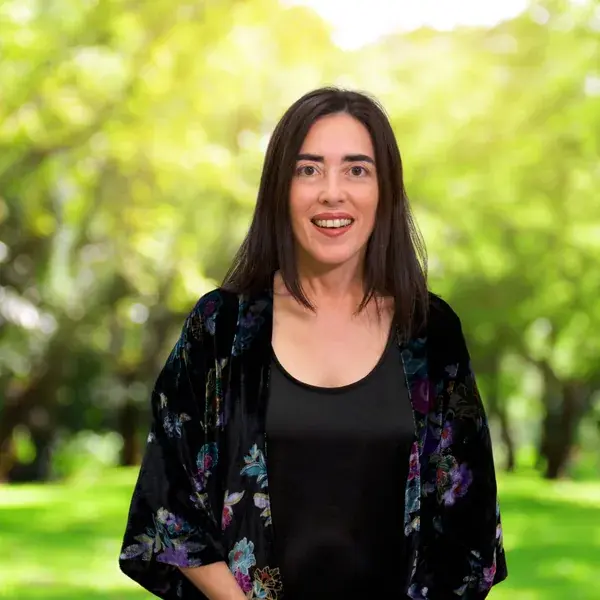
your guide
Dayana Pereira.
Guild Certified Feldenkrais Practitioner. Reiki Master. Somatic educator. Founder of ONE. Doylestown, Pennsylvania, and online worldwide.
I found the Feldenkrais Method in Uruguay when I was twenty, and it changed what I thought a body was. Not something to be corrected. Something that had learned its way into a shape, and could learn its way out again.
That idea still shapes how I work: nothing about you is a mistake that needs fixing.

The thing people say to me most
Some version of: I know all of this. I just can't seem to do it.
What I usually see isn't a lack of effort. Most people have been handed information without being given any way to feel it. I've spent fifteen years learning to explain this work in language you can use on a Tuesday afternoon.
I'm not standing outside any of this
I'm an immigrant. I've been divorced, and it came with a great deal of moving, with two young children to provide for. Starting my own practice wasn't a business plan; it was how I provided for them. That stretch was a dark night of the soul, and it made the work I'd begun in my twenties a great deal less theoretical.
I work on my own contractions every day. The tools I'll teach you are the ones I use on myself, because I need them. Receiving is one of the capacities this program trains, and it's the one I still find hardest.
I teach it because I'm still learning it.
Why this program, and why now
For most of my career this work has happened one person at a time, in a room. I love it that way and I'm not giving it up. But I've watched a lot of people ask about working with me, see what it costs, and quietly go away. I've thought about those people more than they would guess. This is the way in I've been wanting to build for them.
Dayana's training. Feldenkrais: an 800-hour professional training begun in 2007, certified to teach groups in 2009 and to give individual sessions in 2011, plus an eighteen-month post-graduate training in 2017–2018. Reiki I, Reiki II and Reiki Teaching Master. Ongoing continuing education in trauma healing. The Happy Body · XPT Life Coaching · Walk for Life · therapeutic massage · NLP · breathwork · strength and conditioning.
before you ask
The things people actually want to know.
The recordings are valuable practices in their own right. Freedom Is Learned gives that work a different kind of container: a deliberate sequence, live guidance, weekly practice, and time for each lesson to build on the one before it.
Because I’m there with you live, I can witness how the work is unfolding, notice where you may need more support, and adapt the teaching to what the group is actually experiencing.
Think of the recordings as individual practices. This program is the larger learning arc they can become part of, with me there to help you navigate it as it unfolds.
No. This is somatic education. I teach movement, perception and learning. I don't diagnose and I don't treat. If something surfaces that needs clinical support, I'll say so and point you toward it.
Yes. I’m trauma-informed and have additional training in trauma healing, and that understanding shapes how I teach and how I pace the work.
This is not therapy, and I don’t diagnose or treat trauma. But we can work with the patterns of tension, sensation, movement, and protective response that may have been shaped by difficult experiences or prolonged stress. Sometimes, as those patterns begin to change, people experience a sense of release: physically, emotionally, or both.
My role is to provide a supportive container, help you stay connected to what your body is telling you, and follow your capacity rather than pushing past it. We work at the pace your system can actually meet.
Many people choose to do this kind of somatic work alongside therapy, and the two can complement each other very well.
Chronic pain is one of the most common reasons people come to Feldenkrais. Rather than working only with the place that hurts, we explore how your whole body is organizing movement, effort, and support, and whether there are easier options available.
For many people, changing those patterns can change their experience of pain, especially when the painful area has been carrying more work than it needs to.
Every body and every pain history is different, so I can’t promise a particular outcome. What I can offer is a gentle, exploratory way of working that doesn’t ask you to push through pain, and that helps us listen closely to what your body is showing us along the way.
Yes, nervous system regulation is part of the work, but it isn’t the whole picture.
We’ll explore ways to help your system settle when you’re activated, but we’ll also work on something deeper: expanding the range of responses available to you, so you’re not always relying on the same patterns of bracing, pushing through, withdrawing, or overriding yourself.
The goal isn’t simply to become calmer. It’s to have more choice in how you meet what life brings.
Stillness, breathwork and contemplative practices can sometimes bring sensations or emotions into awareness that are easier to avoid while we're busy. That doesn't necessarily mean you're doing the practice wrong, or that one explanation fits everyone. Part of this work is learning how much your system can meet at one time, and how to build capacity without overriding yourself.
No. Every session is live on Zoom, and you take part from home, on your own floor, in your own room. You'll need enough space to lie down and move your arms, and that's genuinely it. No mat required, no equipment.
Feldenkrais is built for exactly this. The movements are small, slow, and done lying down. You'll never be asked to push into pain.
No. Nothing here requires belief. If you have a practice, this supports it. If you don't, nothing will be asked of you.
Yes. If a smaller monthly payment makes it easier to join, you can choose the general rate and pay 3 monthly payments of $397.
The founding rate can also be split into 2 payments of $477. The three-payment option has a slightly higher total, but gives you more breathing room month to month.
Choose the payment structure that feels most supportive and sustainable for you.
Every session is recorded and posted the same day, so if you can’t attend live, you can still stay fully connected to the process.
I do ask that you watch the recording before the next session, because each week builds on what came before. The practices are designed to accumulate, and staying current helps the new learning have time to settle before we add the next layer.
The cohort moves together, and that shared rhythm is part of what makes the program work.
Plan on 10–20 minutes of practice most days. On Tuesdays, your practice happens with me during our live class, so you don’t need to add anything extra that day.
On the other days, you’ll return to the week’s lesson on your own. That regular return is what helps the learning deepen, so the changes you notice in class have a better chance of becoming available in everyday life.
Because I don’t want the work to end when our ten weeks together do.
Freedom Is Learned gives you a focused foundation. Your year inside ONE gives you a place to keep practicing with me live twice a month, continue integrating what you’ve learned, and stay connected to the work as it becomes part of your everyday life.
You’ll also have access to the broader library and community, but the live sessions are the heart of why I’ve included it: you’re not finishing the program and suddenly being left on your own.
You still receive the full year of ONE included with Freedom Is Learned, no matter which payment option you choose for the program.
Your current ONE membership will be extended for a full twelve months starting on the day you enroll in Freedom Is Learned, so you won’t need to keep paying your regular monthly ONE membership during that year.
You simply choose the Freedom Is Learned payment option that works best for you, and your ONE membership is included for the next twelve months as part of the program.

one more thing
Freedom isn't the absence of contraction. It's having somewhere else to go.
You spend a long time "working on yourself."
Reading the material, doing the practices, understanding your patterns better than most people ever will, and still meeting the same wall, at the same place, in the same body.
Contraction can be protective. Sometimes that pattern continues after the original demand has passed.
And contraction can open.
Expansion is the other half, and it's trainable too. A body that can feel what it's doing, and knows how to settle itself, starts giving things back:
A breath that goes all the way down without you asking it to.
A jaw that's soft by default instead of only when you remember.
Digestion that may not have to react quite so quickly.
Sleep with more room to restore you.
A mind that's quiet enough to think clearly in.
None of that is the reward at the end. It's what becomes available once your system has more than one option.
Not so you can finally relax. So that a larger life becomes possible, because you have more ways to meet it.
Begin Freedom Is Learned →Twenty-four people. Starts October 6.